What each report says
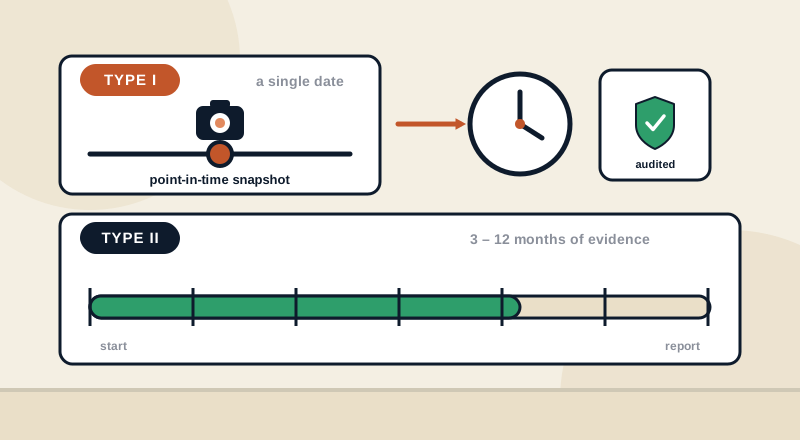
A Type I report describes your controls and gives an auditor's opinion on whether they are suitably designed at a single point in time. A Type II report covers the same ground, and also tests whether the controls operated effectively over an observation period, typically three to twelve months.
Both are issued by an independent licensed CPA firm against the AICPA Trust Services Criteria. Neither is a certificate; both are attestation reports you share with customers, usually under NDA.
Why the difference matters to buyers
A Type I tells a buyer you have designed sensible controls. A Type II tells them those controls actually worked over time, which is why larger enterprise buyers and security teams usually prefer or require it. A Type I is often accepted as a first step, especially with a credible Type II timeline behind it.
Why the observation window sets the timeline
You can build controls quickly, but you cannot shorten an observation window. A Type II cannot be issued until the window has run and the auditor has tested evidence across it. That is why Type II timelines are measured in months, and why starting early is cheaper than starting under a deal deadline.
A common sequence for SaaS startups
- Run a gap diagnostic and fix the largest gaps.
- Get a Type I to unblock stalled deals.
- Start the Type II observation window straight away, ideally with evidence collection automated.
- Renew the Type II annually so your report never goes stale.
Choosing your Trust Services Criteria
Security is always in scope. Availability, Confidentiality, Processing Integrity and Privacy are added only when your customer commitments call for them. Keeping the scope proportionate keeps cost and effort down.
What it costs
Cost has three parts: consultancy support, any compliance tooling you choose, and the CPA firm's audit fees. It depends on your size, scope and starting maturity, so a short scoping call is the most reliable way to get a realistic number.
What auditors ask to see
A SOC 2 audit is built on evidence. Expect requests for records like these:
- Access reviews and onboarding and leaver records.
- Change tickets with approvals and test results.
- Vulnerability scan results and penetration test reports.
- Incident records and how each one was closed.
- Supplier reviews for the vendors that touch customer data.
- Security training completion and approved policies.
- Backup and restore test results.
For a Type II report the auditor samples these records across the whole observation window, so a control that ran well in month two and lapsed in month five will show up as an exception.
Mistakes that delay a report
The first is starting the observation window before the controls are ready. Gaps inside the window become exceptions in the report, so it is usually better to close the known gaps first. The second is scattered evidence: screenshots in chat threads and tickets nobody can find. Pick one place for evidence and keep it current. The third is scope. Adding all five Trust Services Criteria when customers only asked for security adds cost with no buyer benefit. The last is no owner. Every control needs a named person who answers for it.
If you want a plan for your own situation, our certification support page explains how the work runs, and a gap diagnostic is the usual first step.
Next step
Tell us which customers are asking and by when, and we will recommend a sequence. See our SOC 2 page, our guide to SOC 2 for startups, or book a free advisory session.